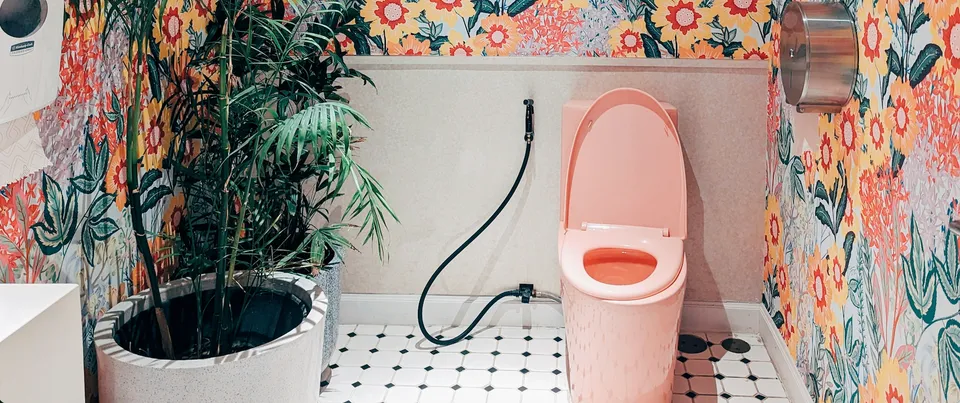
Imagine you are 37 inches tall and you need to pee.
First, you need to climb onto a curved lid that is about your waist’s height and it is wet and cold. You balance awkwardly with your legs dangling while you do your business. The automatic toilet flushes aggressively from behind while you’re reaching for the toilet paper, sending your heart rate suddenly to 120 bpm. You fall, face first onto grimy tiles.
In 2020, the percentage of people in the U.S. aged 0 to 9 was roughly 11.7%. Why are public toilets accommodating small bodies so rare? Note that, in the United States, public toilets themselves are rare, with about 8 public toilets per 100,000 people. In New York City, there are 4 per 100,000. So, the situation is dire to begin with, but if you’ve ever cared for a small child in a public area, you might have wondered where all the tiny toilets are. The question itself is hilarious on one level, but underneath it is yet another serious question of bathroom access.
Why, then?
Data on toilets is frustratingly difficult to access. QS Supplies introduced an oft-cited Public Toilet Index, which appears to be cobbled together from different crowd-sources, including the original crowdsourcing mechanism, censuses. I reached out to a couple toilet purveyors, including Throne Labs and Simple Project, without luck. I can conjecture, based on what I know about design and bathroom access, so let this be my caveat for the following diatribe.
Affordances are invisible and that’s the issue
Let’s talk about affordances for a second. The interaction design foundation defines an affordance as “an action possibility in the relation between user and an object”. Basically, it’s the relationship between a user’s ability and the tool they’re using. As such, while evident to the user, it is invisible to the third observer, as many other relationships are.
Consider the relationship between a circle and this line.

What is the relationship, precisely?
Well, it’s not obvious until you see them overlaid:
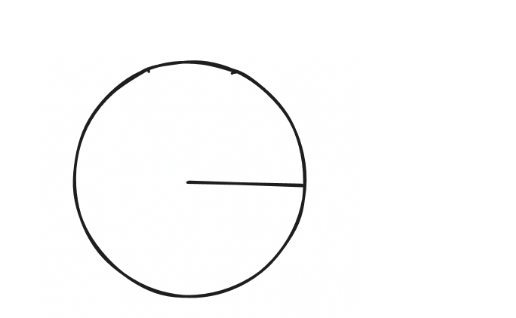
The line is the circle’s radius. The same thing can be true of a human couple. You may not know a person is in a relationship until you see them interacting with their partner, kissing or taking out the trash. I guess that’s why engagement rings were invented, aside from the obvious economic benefit to jewelers.
A relationship can be between two objects, as with the line and circle, or between two people. It could also be between a person and an object: an affordance falls into this category. Think about a person and their purse or wallet. The purse or wallet affords carrying around personal effects. This relationship is at the core of all product experiences including accessible furniture, like small toilets, however, it’s invisible. There’s a way of making the invisible visible when it comes to affordances. User testing surveying a wide range of users sheds light on issues different users might have. I’m not sure how toilet surveys are conducted, but I’m pretty sure that unless the toilet is small, the surveys don’t include children. If children were widely considered from the beginning of the design process, toilet design might be very different. Which brings me back again to the question, why?
Accommodation does not equal coddling
In my search for the answer to this question, I found a reddit post where someone was asking the same question about toilets, with this response:
“in part because the majority of paying customers at businesses are adults. Unless a business is geared towards children as patrons, such niceties are not going to be bought/supplied/cleaned/maintained/replaced. Pick your kid up and put it on the toilet.“
Note the use of “it” here. There’s also an assumption that the bathrooms we’re talking about here are for paying customers only, which doesn’t fall into the definition of a truly public bathroom.
However, I suspect that this “paying customer” aspect of the problem is at the root of the matter. This is the real answer to the question: Children have no money, consequently, they’re voiceless in terms of bathroom access. In a society that places a person’s value on their output, children have no value. They’re a sink of money, of energy, and of time. This assumption: that a person is only worth noticing if they provide tangible benefits (money) to others, means that “children should be seen and not heard” is not an extinct attitude. And yet, I maintain that each child is a complete person, regardless of how far their development stage is from adulthood.
In the U.S, we often use the word “public” to mean both bathrooms funded by the state and bathrooms funded by businesses, even if that’s legally incorrect. I think both types of bathrooms should accommodate children better.
If someone were to play devil’s advocate: why should we accommodate children when we can pick them up and put them on the toilet? Well, an adult is not always going to be there, for one reason. The other reason is that when we provide children with the tools for independence, they become emotionally, mentally, and physically independent of us. It’s a tough thing to come up against when it’s so easy to feel needed, powerful, and loved around a child, but the true work of an adult with a child is to train the child to not need the adult.
When it comes to an environment for a child, accommodation increases independence and enables them to do more things for themselves, independently.
Internationally renowned childhood expert Dr. Maria Montessori said:
“Any child who is self-sufficient, who can tie his shoes, dress or undress himself, reflects in his joy and sense of achievement the image of human dignity, which is derived from a sense of independence. “
Making it impossible or uncomfortable for a child to use something without help is not accommodation. Providing smaller furniture, on the other hand, is not coddling, and we should not have to be paid to want to do this for the future of humanity. Plus, I’m sure there are plenty of adults with smaller bodies, or adults who want to squat for their digestive health, who would appreciate smaller toilets.
Anti-enshittification
No pun intended. I wish I knew more about the toilet design & fulfilment process. If you do, please reach out!
Meanwhile, there is something we can do, a sort of halfway point to providing fully accessible furniture for kids. Provide a stool for them. They’re cheap, they fold up easily, and stools go a long way towards making bathrooms accessible for children. In my town, businesses with children specifically in mind often provide child-size toilets, for example, the Montessori schools, and the public library. But in other places that have a high number of children using the bathrooms but less of a budget, like my parish, provide a stool in the bathroom. In our house, we have four or five stools sprinkled throughout the rooms.
If you provide a bathroom as part of your business, I recommend looking at it through the lens of equity, instead of what paying customers demand. In the end, I think everyone will be happier to use your bathroom the more comfortable for everyone it becomes.
Even if children don’t pay you, provide accommodation for children in every place where they can be, not just where they will be. Consider it your good deed for the month, hell, for the year if you’ve gone ahead and installed a tiny toilet. If you want to, add a performative sign out front. I don’t care how much you’re virtue-signaling, if you’re actually practicing virtue. Get a stool at the very least, and you can empower every child that visits your bathroom, and that counts for something.